Category Archives: Tandems

Dialing in our New Co-Motion Java Tandem

Earlier this year, Felkerino’s and my new tandem arrived from Co-Motion. Some of you may remember that  a crack developed in the stoker seat tube of our previous tandem, a Co-Motion Speedster, which required either a mend or a replacement frame.

We ultimately chose to replace the frame and, rather than another Co-Motion Speedster tandem, Felkerino and I decided on a Co-Motion Java, which is their 29-er frame.

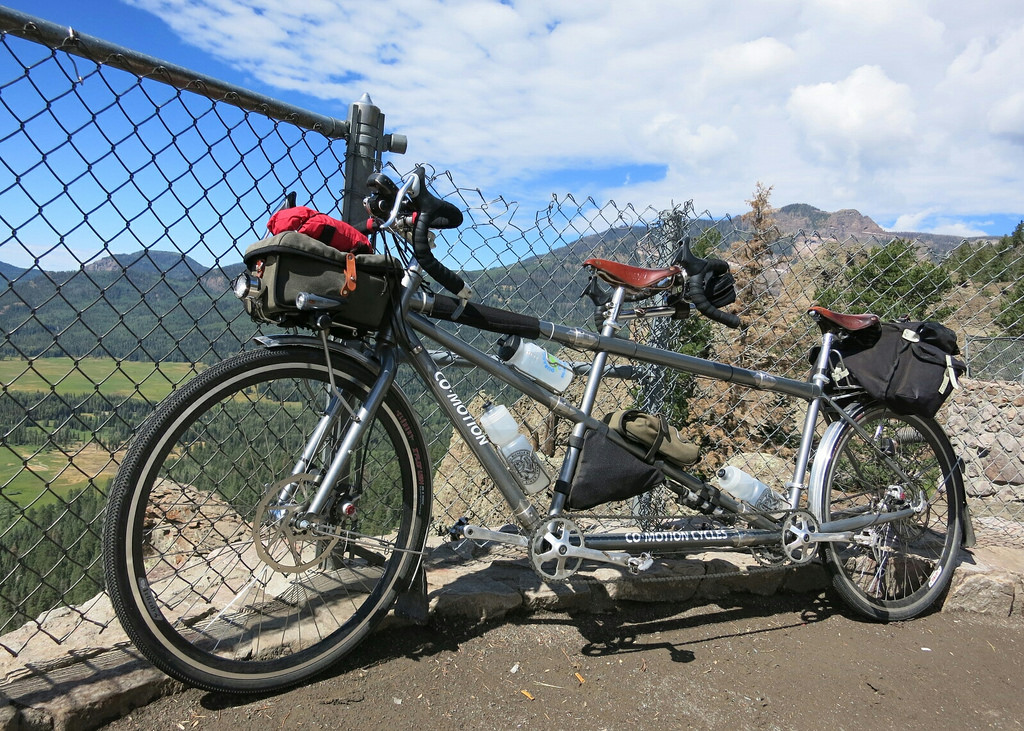
Co-Motion Java on Whites Ferry

Co-Motion worked out an arrangement with us for the new bike which was primarily financed by the sale of my 1996 Nissan Altima.

That’s right. I sold my car to buy a tandem. Righteous bicycle purchasing!

Co-Motion describes the Java as an “ultra-rugged” bike, and its tubing is beefier than the Speedster with clearance for larger tires. When I first laid eyes on the bike, its ultra-ruggedness intimidated me.

The crazy clearance on the front fork reminded me of the jaws of an alligator. The tubing had me wondering what type of riding Felkerino had in store for us.

Co-Motion Tandem at Sugarloaf

Since that time, we’ve (alright, Felkerino has) been meticulously building the bike up and dialing it in to suit the kind of riding we plan to do– primarily randonneuring, touring, and dirt road riding.

The past three weekends we’ve taken the bike out for longer training rides on hilly terrain (106, 92, and 93-miles, respectively) not just to shake down the bike, but also to build our base fitness and prepare for the upcoming spring bicycling events we hope to do. And because tandeming is fun. Most days.

There’s a lot that goes into dialing in a bike. First, the fit. Saddle height, setback, and handlebars must be tweaked just so.

Fenders must be installed. At least, if you’re Felkerino or me, that is something you must do.

Pink fenders on the Co-Motion? No

These pink fenders got the thumbs down from the captain, as Felkerino insisted on metal fenders that were not pink.

Operation Rattle Battle 2013 with the Co-Motion

Persistent fender rattles have to be fixed or no one will want to ride with us and I will eventually lose my mind.

Custom mudflap and a fender solution!

Custom mudflap and a dual bolt rattly fender solution

The fender rattle battle waged on and on in the Dining Room Bike Shop until Felkerino finally drilled a hole for two bolts on the stay, as you can see in the photo above. Rattle battle over!

After you add fenders, you also want to be sure to affix any custom leather mudflaps your friends have made for you. Thanks, Alec.

The ideal front bag should be installed to coordinate aesthetically with the bike and, more importantly (I suppose), to allow the captain to easily access all the essentials he wants at the ready.

Gilles Berthoud

Gilles Berthoud

He says Gilles Berthoud.

Sackville = like

Sackville = like

I say the Berthoud is too little for our burly new bike. How about this Sackville?

Other miscellaneous wrenching must occur at various points during a tandem ride.

Wrenching the Co-Motion

Ideally, said wrenching will occur in a sunny spot.

The initial hesitancy I felt about the Java’s rugged look has dissipated and when I ride it, aside from still being impressed by the size of the top tube, I don’t detect a particularly slower feel from it. If anything, the Java is a lively ride and DEFINITELY far more responsive than the dear old Lead Sled we used during the interim.

I still miss our Speedster, as it was a beautiful bike that was also the first tandem to fit me perfectly. However, I am pleased with how the Co-Motion Java is shaping up, and have no reason to doubt that the Java’s fit will be any different, as it was also custom-sized for Felkerino and me. I’ll report back more fully after we’ve put some brevet miles on it.

Co-Motion tandem

In the meantime, I’m going to check on Felkerino to see if he has changed out the front bag again.

Reviving the Lead Sled: our Cannondale Tandem

Due to unforeseen circumstances (to be discussed in another post), our Co-Motion tandem will not be around for a while. In the meantime, Felkerino and I still want to tandem together so we decided to put our original brevet tandem, a Cannondale mountain frame, back into service for some summer rides and any upcoming fall brevets we do. Because of its industrial dark gray hue and bulky aluminum tubing, Felkerino nicknamed it the “lead sled.”

Cannondale tandem, back in service

Felkerino invested some serious time this past week to make the Cannondale rando ready. He put on new tires, transitioned our saddles and handlebars over from the Co-Motion, and measured and remeasured to mimic our Co-Motion measurements as much as possible.

This weekend we took the lead sled out for a 73-mile shakedown ride to see how it- and we- would fare. While it’s quite a switch to go from riding a steel tandem that’s been made especially for you to a stock Large-in-front, Medium-in-back aluminum-frame tandem with 26-inch wheels, our ride went better than I expected.

There is no doubt that the Cannondale has served us well. We rode it through our first two seasons of randonneuring together, and we put it through its paces on the Cascade 1200K in 2006. Since Co-Motion built our tandem, though, the Cannondale has not seen much use.

Having grown so accustomed to the fit and feel of the Co-Motion, I was apprehensive about reviving the Cannondale. I was also bummed that riding the Co-Motion was not an option.

I love tandeming with Felkerino so I had to get over being bummed out and get my bum in the stoker zone. Once we dialed in each of our fits as best we could and made it out on the open road, I have to say I enjoyed riding the bike again. It was like rekindling a relationship with an old frenemy. I mean, an old friend. We’ll have to see how we all get along on longer rides, but for 73 miles the Cannondale felt good, albeit distinct from the Co-Motion.

Cannondale tandem, i.e., the lead sled

  • Stiffness. The Cannondale is a much stiffer ride than the Co-Motion. It’s hard to explain, but when we stood up on the pedals for some standing climbing I felt the stiffness of the Cannondale radiate from the balls of my feet. The Co-Motion, in comparison, has a little more give to it and does not feel so rigid when we climb.
  • Tire Size. Being a mountain tandem, the Cannondale is ideally suited for 26-inch wheels (unlike our Co-Motion which takes 700Cs). For this go-round with the lead sled, we decided to use wider tires than we did in the past, as we found the ride rather unforgiving. This time, we’re riding 26 x 1.5-inch tires and it has made the ride smoother. Bumps don’t cause as much of a jolt as they did with 32s. The slightly smaller and wider tires add some rolling resistance, which is noticeable on the downhills as we give up one or two miles an hour, but the added comfort is worth it.
  • Handlebar Reach. The Cannondale is over two inches shorter in the stoker zone, making the fit somewhat of a compromise. The space in the stoker zone of the Co-Motion is ideal; it’s like having my own studio apartment. I can ride easily on the top of the bars as well as the hoods. When riding the Cannondale, I much prefer to spend my time on the hoods so that I can get a little more stretch. The handlebar reach will never be perfect on this bike, but it works alright for now.
  • Setback. I found the setback on both bikes to be comparable thus far, thanks to the Velo Orange Grand Cru seatpost I’m using on the Cannondale. I did not find myself pushing back on the saddle this weekend, as I had during previous rides on this bike. We’ll see how it goes on longer rides. Knowing that the overall stoker zone is a couple inches shorter than the Co-Motion, I’m a little apprehensive about how the reach and setback will be on rides of 100 miles or longer.
  • General Size. As I mentioned, the Co-Motion is one large bike, with a much higher top tube than the Cannondale. Felkerino said that the Co-Motion practically requires him to be a Rockette to step over it. I actually do not recall the standover height of the Co-Motion and since it is in the bike hospital, I cannot take any measurements. In contrast, the Cannondale top tube is much lower. That also means that the fistful (in this case, four inches) of seatpost that is visible on the Co-Motion is 7 inches of visible seatpost on the Cannondale. When on the Cannondale, I’m looking way down at the top tube on that bike. It will take time to readjust to the feeling of a slightly smaller and shorter frame.

Felkerino and the Cannondale tandem. See what I mean about the top tube?

Thankfully, the Cannondale felt pretty good for the duration of our ride. There are kinks to be ironed out, as to be expected with any bike that has not been ridden for a while and that you want to put back into service for more rigorous riding.

This weekend our 40-spoke rear wheel popped a spoke at the head and now needs to be rethreaded. Great. (Better now than in the middle of nowhere, right?) We need to install fenders. The 26-inch tire stash needs to be inventoried and reviewed. Felkerino and I will tinker with our positioning until it feels as optimal as we can get it.

I’m heartened. After almost a month off of the tandem, we’re back at it. We’re not on the tandem I expected, but given that the Co-Motion is unrideable I feel fortunate to have a reserve tandem that’s performed solidly for us in the past. We are determined to make the Cannondale a solid touring and randonneuring bike that will once again meet our tandeming needs.

Paris-Brest-Paris by Tandem

Have you heard enough about PBP yet? Well, hang on just a minute, because I’ve got one more story to share with you.

Felkerino and I co-wrote a short piece about what it meant for us to complete this past August’s Paris-Brest-Paris by tandem. It was published in the most recent edition of American Randonneur, the quarterly newsletter distributed by Randonneurs USA.

Felkerino and me, with Rob Hawks on PBP 2011 (c) Antoinette Galon

Randonneurs USA members may have already seen the article, but for those who have not, we decided to post it over at one of my favorite blogs, The Daily Randonneur. Click on over and check it out. It will make you immediately want to buy a tandem and start training for PBP. Kidding, though I do hope you like it!

See you on the road, everybody.

Bikes to Like: Lowell and Cheri’s Santana Sovereign

Last year I watched as Lowell and Cheri completed a Super Randonneur series on their beautiful Santana tandem. It was pretty cool to see, as Cheri had recently started randonneuring, and not only completed an SR series, but went on to complete an R-12, too! Their Santana always looks so good, that I just had to ask Lowell to tell me more about it. Lowell responded:

Asking a randonneur about their bike is probably considered a tactical blunder, similar to asking grandparents about their grandkids– you’re going to get more information than you really needed, or wanted. So, with that in mind…

1. What kind of bike do you have?

We have a 1987 Santana Sovereign. It was purchased new at the Two Wheel Transit Authority bike shop in Huntington Beach, CA. There weren’t a lot of commercially available, quality tandems back in those days. Santana was really about it, unless you wanted custom.

We had test ridden several different brands and models and pretty much settled on the Santana Arriva. I was a battery commander at Twentynine Palms, CA at the time and we trooped down to the coast to test ride the Arriva one last time before making a decision.

When we returned from the test ride, the salesman had pulled out the Sovereign and we took the bait. Within a few blocks Cheri and I agreed that this was THE BIKE. We could feel the difference. Although we suffered “sticker shock”, we were the proud owners of a beautiful blue Sovereign, which has been a member of the family ever since.

The bike remained pretty much the same as bought through the years, until the fall of ’08, when Cheri decided that she would like to increase her “saddle time.” We hadn’t ridden the tandem much since moving to Virginia, and after the first couple of rides on the scenic roads around Warrenton it became glaringly apparent that we needed more… well, everything.

Equipment changes began incrementally, but when Cheri decided that she wanted to start doing brevets with a goal of the 2010 SR series the modifications began in earnest. Just about everything on the bike has been upgraded, with a focus on the demands of randonneuring.

But the heart of the tandem remains the artistic, fully butted, Columbus tubed, fillet brazed frame. Regardless of the accumulated “battle scars”, it is still a beautiful bike. At least we think so.

Lowell and Cheri on the 2009 Flatbread 200K (c) Jim and Chip

2. Where do you ride it?

We’ve come to the understanding that to truly enjoy and appreciate tandeming you have to get out on the open road. Riding around suburbia just isn’t fun.

We have several favorite centuries/brevets out of Frederick, Maryland, along with a couple of routes through the Virginia horse country. Of course, all these rides have a lunch destination.

3. What do you like about your bike?

Its adaptability. Over the years it has been configured and outfitted to meet our requirements at the time. Our first son, Geoffrey, was pulled along in a trailer. When Eric came along we bolted kid seat on the back and Geoff followed along on his own bike. Later, I was able to adjust the captain cockpit so that Cheri could Captain with Geoff as the Stoker and I pulled Eric in the trailer with my single bike.

It has also been rigged with full racks and panniers for loaded touring. While the bike itself is 24 years old, we were able to upgrade and modify it to make it into a very competent and comfortable brevet bike.

Just recently I modified the gearing and set it up to haul our B.O.B. trailer for a short tour to celebrate our 34th wedding anniversary. I think it’s safe to say we got our money’s worth.

Cheri, Lothar, Joel, and Lowell finishing the 2010 600K

4. If you had to describe your bike in one word, what would it be?

Smoooooth! It’s like riding in a luxury car. Make no mistake; this is a heavy bike, relative to most modern tandems. But it is so comfortable it is an absolute joy to ride.

5. Fenders or no fenders?

Fenders! Absolutely! Honjos with leather mud flaps. One of the cardinal rules of tandeming is to ensure the Stoker‘s backside stays as free from road spray as possible, thus avoiding the non-stylish “racing stripe” look.

Editor’s note: I approve of this rule!

Lowell, Cheri, and Cliff. Fall riding on the 2010 Cacapon 200K

6. What is one of your favorite memories of this bike?

Probably the North Carolina Bicycle for Life 400K in July 2010.

We had to do this ride as a makeup for DNF’ing the DC Randonneurs Frederick 400K when we blew the transmission in true randonneur fashion. Our free hub expired. We had 100k to go, it was midnight, in the rain, and we were at the top of the mountain 20 miles from anywhere. I have to put a plug in for Chuck and Crista who came to our rescue.

The post-ride Tandem Team debriefing was quickly concluded when the Co-Pilot/Chief Financial Officer (that would be Cheri) told the Pilot/Chief Mechanic (that would be Lowell), “I don’t care what it takes, just get us back on the road.”

Alrighty, then, that makes things easy. We built a new rear wheel around a Phil Wood hub, upgraded the rear derailleur, put on a new cassette, and we were back in business just in time for the DC Rand 600K.

Just a couple of weeks later we were in North Carolina, grinding up the mountain to the control at the appropriate named Little Switzerland. After a short stop, we continued climbing on the Blue Ridge Parkway for another 12 miles. By the time we pointed the bike downhill it had become very dark and we were beat. But the following 15 mile, curvy, high speed, nighttime decent was exhilarating. The tandem handled like it was on rails. We were rejuvenated, recovered and ready to push on to the finish. Flying down out of the mountains was awesome and memorable.

Hanging out before the Warrenton 200K

7. Does your bike have a name? If so, what is it?

Strangely enough, after all these years, it doesn’t. We have always just referred to it as “The Tandem”.

8. What is your favorite accessory on your bike and why?

It has to be the Cateye Dual Wireless computer for the Co-Pilot/Primary Navigator (that would be Cheri). We tried several wireless computers for the Co-Pilot and none worked consistently. The Cateye has performed like a champ for thousands of miles. No more excuses from the Navigator’s station.

9. If you bike could talk, what is the one thing it would say to you?

“Wash me!”

10. What did I forget to ask that you want to tell me about your bike?

That about covers it. We have truly enjoyed tandeming over the years. Whether it’s a 50 mile ride on the W&OD Trail or completing a 600km brevet, riding this bike never fails to bring enjoyment to the team.

Thanks, Lowell! You and Cheri have a great bike, and I look forward to seeing you both on the road sometime soon!

Bikes to Like: Ron and Barb’s Burley Paso Doble Tandem

I remember the first time I rode with Barb and Ron. I spied the Berthoud bag adorning on their steel Burley, their matching Swobo jerseys, and thought to myself, “These are some stylin’ randonneurs. I must find out who they are.” And so I did. Ron and Barb are great randoneuring buddies with wicked senses of humor and one awesome  tandem. Don’t believe me? Read on, my friends!

Barb and Ron

1. What kind of bike do you have?

We have a 2006 Burley Paso Doble tandem.  It’s a mid-price range Burley with a True Temper steel frame and Ultegra drivetrain. We bought it at Tandems East during their ’06 spring Tandem Expo. We went to “just look.” That Mel is a clever guy holding his open house at just about the time of year people are expecting their tax refunds!

2. Where do you ride it?

We ride mostly near home in New Jersey. We routinely ride brevets in both New Jersey and Pennsylvania with occasional forays to surrounding east coast regions for variety.

Burley, Swobo, and Berthoud goodness

3. What do you like about your bike?

Our Burley has adapted very nicely to what we’ve asked of it. When we bought it we had never heard the word “randonneuring.” After more than a few changes (ditched the STI levers for bar ends, new wheels with sturdier rims and wider tires, etc., etc.) it serves as a very comfortable, reliable, competent ride over the longer distances.

4. Fenders or no fenders?

Yes FENDERS! In fact I think I may be a little obsessed with fenders. I’ve gone through several different variations, made every mistake you can make, and spent more money than I care to admit trying to fit a set of fenders “just so” on a bike that wasn’t really made to fit them.

I am very proud of my custom installation of a set of SKS/Esge plastic fenders mounted with a pair of Berthoud aluminum stays and topped off with a PDW Fenderbot light. Or I should say, I WAS very proud of my custom installation until 5 miles into the Boston 300k last Saturday we hit a bump and the rear fender cracked completely in two at the stay. We had to stop and manually rip the remaining fender off so it wouldn’t get caught in the wheel and cause an accident. I’m presently pondering whether to try (again) to mount some metal fenders or give it another go with the SKS’s slightly modified to avoid breaking.

5. Does your bike have name? If so, what is it?

We never felt the need to name our Burley. Not even quite sure if it’s male or female (or how to tell for that matter…). I suppose a Paso Doble should have a Latin name. Maria…? Esmeralda…? Salvador…?

6. What is your favorite accessory on your bike and why?

I’m really fond of our Berthoud handlebar bag, or as I like to call it our designer French luggage. It rests on a Nitto rack that was custom fit to the fork by Stephen Bilenky of Philadelphia.

Barbara wanted me to say that her favorite feature of the bike is her captain, but I won’t let her. It’s way too mushy! She also likes the little $10 piece of stainless steel that holds her waterbottles upright and within easy reach.

7. What is your favorite photo of your bike/your bike and you?

I’ve always been really fond of this photo taken by Maile in the early morning hours of the 2010 New Jersey 400k. It makes us look fast!

This is a pretty good shot of the bike just leaning on our garage:

Burley Paso Doble

I also like these two that Felkerino and you took of us at last year’s Civil War Tour:

Ron and Barb on the Civil War 200K

Ron and Barb at the Civil War 200K

8. What did I forget to ask that you want to tell me about your bike?

Did I mention it’s PURPLE? In photos or in low light it often looks black, but get it in the sunlight and it’s a beautiful deep metallic flecked purple. If you catch it at the right angle it can sometimes look green.

Thanks to Ron and Barb, for sharing all the great details about your fine randonneuring tandem! Also, who knew that fenders could be such a complicated issue?!

Nostalgia Edition: A Tandem Century First Date

Felkerino and me. (c) Bill Beck

This month marks the sixth year of the formation of Felkerino’s and my tandem team. Felkerino’s and my first date was a century ride on a tandem bike. As our friends well know, I never tire of telling that story!

Four Super Randonneur brevet series’, one 1200K, a 1000K, and several summer tours later, here we are today. Still riding tandem together.

The Co-Motion along the C&O Canal

If there is one thing I’ve learned in six years of riding tandem, it’s this. If anyone ever asks you to ride 100 miles on a tandem for your first date, say no.

I mean it. Just say you’d like to noodle around for 20 miles or so and see how you all do together. And when you do that, make sure to ask for the following:

  1. A physical inspection of the bicycle, particularly the stoker zone;
  2. References from other cyclists who have ridden with the person;
  3. A written essay from the potential captain, detailing his or her views regarding bike safety;
  4. A proposed list of conversation topics that may come up during the ride; and
  5. A cue sheet of the proposed route, making sure that in includes shortcut options.

A tandem ride is a tricky first date. You put a lot of trust in the hands of a stranger if you happen to be the stoker. You trust that the bike is road-worthy and that the captain has the faculties (both mental and physical!) to know what he or she is doing up front. You cross your fingers that your riding style is compatible.

Further, if you commit to a century and the two of you don’t click, you are stuck together on the same bike for a long time. 100 miles long, to be exact. Lots of time for awkward silences and wondering how you got yourself into this mess. That is emotional pain. If the bike doesn’t fit properly, you are also in physical pain. Who needs more pain in their life?

I didn’t give those things any thought when I got on the tandem for the first time. I just said to myself, “This will be fun!” and off we went. It was, lucky for me! Phew!

The Co-Motion Tandem.

Perhaps throwing caution to the wind might work out for you as well as it did for me. But it’s a risky plan, only for the foolhardy. Go for the noodle ride and call it a day. There will be plenty of other days for long rides, if everything goes well on the short one.

Plus, I love being the only one on the block with the cheesey tandem century first date story.

Missing the Bike and Thank You Notes: Co-Motion Tandem Edition

After I finished writing my Quickbeam “thank you” note for Lovely Bicycle’s recent “Thanking Your Bicycle” giveaway, I started thinking about Felkerino’s and my Co-Motion tandem and all the great experiences we have had with it. That Co-Motion is one awesome bike, I thought. It also deserves a few lines.

The Co-Motion on Skyline Drive

Dear Co-Motion Tandem,

I was thrilled when I found out you were going to be part of my life. A bike made especially for Felkerino and me? Fantastic! Remembering the day we brought you home still brings a smile and a thrill up my backbone.

Thank you for making Felkerino and me famous. I wasn’t nearly so popular until I started riding tandem. Now, when Felkerino and I go out with you around the countryside, people often wave, say hello, or ooh and ahh as we go by. I know their reaction is not because of us. It’s the magic of the tandem. It’s you, baby, YOU. But because you cannot speak, we are the beneficiaries of your enticing aesthetic.

Of all the bikes I’ve ridden, you are the one I/we ‘ve put to the greatest test. You are the one we’ve turned to for most of our brevets and multi-day tours. Thanks for putting up with the extra tinkering, roof rack travel, and high expectations. And thanks for not getting ticked off during the occasional tandem team meeting. I’m sure you had an opinion, too.

Our Co-Motion Tandem

Felkerino and I ride tandem together a fair amount, with our longest tandem ride being a 1200 kilometer grand randonnee. I only share that with you in an effort to brag socially unacceptably establish my tandem credentials.

While we initially rode a Cannondale mountain tandem and built it up as a touring bike, we eventually made the investment in a custom Co-Motion tandem. This was due to a variety of factors. Felkerino could never seem to get the reach quite right from the captain position, the stoker zone was on the small side for me, and we wanted a tandem that fit 700C wheels.

It was when we purchased the Co-Motion that I knew Felkerino and I were destined to be together for a while. At least until we got some good long miles out of that bike.

The Co-Motion is an awesome riding machine. Its responsiveness compared to the Cannondale was notable from our very first ride on it. We step out of the saddle to climb and the Co-Motion is right there with us. With our Cannondale, it sometimes felt like we would begin climbing and it would take a minute or two for the bike to concur with our decision. Felkerino used to call it the lead sled for that reason.

Riding the Co-Motion (c) Bill Beck

Our Co-Motion fits us both so well that we experience longer brevets and multi-day touring quite comfortably. Felkerino purchased the Nitto Wayback seat post with super setback in order to make his fit up front ideal. At least that’s what he told me. He may have just wanted an excuse to buy a lugged seat post, I’m not sure. I, however, am quite comfortable in the stoker zone with my Velo Orange Grand Cru seatpost. Its setback is just right for me.

This is the only custom bike I’ve owned (I guess I own the rear half?) and I must admit that having a bike made for your body and riding position is pretty nice.

The Cannondale did a good job getting us from point A to point B, but our Co-Motion is outstanding.

The one area where the Cannondale out-performs our Co-Motion is with regard to loaded touring. We built our Co-Motion with the intention of using it primarily for randonneuring. In our heads, we hoped we could use it both for randonneuring and loaded touring. However, it hasn’t worked out that way. When we add four panniers or a heavy load to the Co-Motion, it simply doesn’t handle that well. Given that all of our touring to-date has been hotel touring, that isn’t so critical. We just make sure to pack light.

If we do decide that we’d like to tour with tents and sleeping bags, we’re buying another custom bike loading up the Cannondale and leaving the Co-Motion for brevets and light touring.

In the meantime, it’s all Co-Motion, all the time.

Bikes to Like: Cannondale Tandem

This week I’ve been reminiscing about Felkerino’s and my very first tandem, a dark gray aluminum Cannondale mountain frame.

Cannondale Tandem en route to Niagara Falls, 2005 with early Burley trailer prototype. (c) Lynn and Steve

During our first two years plus of riding together, the Cannondale tandem was our steed of choice.  We took it on tour from Rockville, Md. up to Niagara Falls, made it through two Super Randonneur series’, and even rode it on the Seattle International Randonneurs’ Cascade 1200K in 2006.  It was a great long-distance touring bike for us.

Randonneur-approved! Washington Pass on the Cascade 1200K, 2006.

These days the Cannondale tandem isn’t seeing that kind of action; it’s on another type of adventure. Felkerino and his daughter now use it for getting around the streets of Washington, D.C. (and even Arlington, Va., if we feel really inspired).

Felkerino and daughter DF, riding along the Waterfront

Converting the tandem for Felkerino and DF allows us to still use our bikes as our primary mode of transportation. That makes me happy because I only somewhat like Metro and I really don’t like driving. And it makes Felkerino happy because he loves having many velocipedes in the rotation.

A tandem is not something most people see every day, although I have noticed that there are at least one or two tandem commuting couples in the city. People love watching Felkerino and DF ride together and I often hear exclamations from children as well as adults about the “two-people bicycle.”

The Cannondale was a good brevet bike for us and now it is perfect for use on around-town errands and touring about. It’s a great transportation solution for the three of us.  Everybody rides happy. Most of the time, anyway!

Hey, did you hear the news that Friday is here? It’s true! Happy mailbox chasing!