Category Archives: Rando Reflections

The Dogs I’ve Met Through Randonneuring

Dog-Runner 3

A Terrifying Beginning

When I was a kid, I developed a serious apprehension about dogs. This feeling was exacerbated when I rode my bike, largely because one of the rural roads I often traveled was also home to Snoopy, the big mean biting dog.

Snoopy was always in her yard, lying in wait for innocent targets like my sister and me. As we approached, Snoopy would charge across her lawn and out into the road.

Her mission was always simple and scary: bite children’s ankles as much as possible.

Fear welled up inside me at the sight of Snoopy, and I would always yell at her, in what I’m sure she heard as a terrified tone. “Back, Snoopy! No!”

Snoopy knew I was bluffing, and stayed focused on the prize that was my ankle, or any other part of me that she could nip on.

Because encounters with Snoopy, the big mean biting dog, occurred so regularly during my early cycling years, I grew up thinking that all dogs in the country were:

1. Unchained; and
2. Ready and raring to eat me if just given the chance.

I grew up and moved away from rural life. I eventually settled in Washington, D.C., and Snoopy the big mean biting dog, became a fuzzy memory.

Until I took up randonneuring, that is. Through cycling with the D.C. Randonneurs, I was re-introduced to rural life, Mid-Atlantic edition.

On my first rides through the countryside, memories of Snoopy loomed large whenever I spotted a dog or heard one yowling in the distance.

Over time, though, I realized that not all country dogs are like Snoopy, the big mean biting dog. In fact, most are not. My completely unscientific study of them over the years has shown that a variety of dogs exist in the country, and they often make for quite pleasant encounters. Not always, but enough that I don’t equate all dogs to Snoopy.

Here’s a sampling of the dogs I’ve come across on rides. I’m sure I missed at least one or two so please let me know in the comments. I do not want any country dog feeling left out!

The Bluffer

Dog-Bluffer

These dogs are often on the small side and know that, at a minimum, they must defend the fort with the fiercest barks they can muster.

As soon as they discover a cyclist passing by, they launch themselves out of the yard and position themselves either at the end of their property or on the road and begin howling away.

Dog-Bluffer 2

While the barks themselves might intimidate, the fact that they are coming out of a fluffy dog that you know you could clearly deal with if needed makes them easily managed encounters.

Bluffers do not extend much, if at all, beyond their property lines and clearly do not want to make physical contact. Rather, they want to establish who is they mayor of their turf and it is not you.

The Runner

The majority of dogs I’ve met on rides are runners. They see cyclists passing by their home and it makes them want to stretch their legs, too.

“Hi cyclists! Where are you going? Let us keep you company for a bit,” their actions seem to say.

Dog action shot. The runner.

Dog action shot. The runner.

Some runners are restrained from the road by the invisible fence collar gadget, which only allows them to run alongside you at a distance from the comfort of their own yard. Others have no restraints, happily bark out a welcome, and then take great pleasure in running either alongside you on the road (for the intrepid) or along the shoulder (for the more timid dog that lives in an area where there actually is a shoulder).

Dog-Runner

These dogs are lots of fun to see on rides. They mean no harm, don’t veer perilously toward you or your bike, and just want to share in a few paces of your adventure.

Chained-Up Wild Card

Lots of dogs I see in the country are leashed or restrained by a fence (either electric or wooden) around their property. They have space to run, but unless they break through the fence, they are yard-bound.

Occasionally, I also pass dogs that have been chained up, leashed, or kenneled. While I am glad to know that these dogs cannot accost me, seeing them restrained this way also saddens me.

What kind of life is that? I wonder. It does not seem like a good life for a dog. Maybe it’s because I grew up in the country where space was a given and most dogs were not leashed.

That said, the barks of some of these dogs and the forcefulness with which they pull against whatever device confines them to their yard makes me think it might be better for them to be leashed than roaming freely. These are the wild card dogs. You do not know what they would do if they were free.

The Naïve Puppy

If you see a dog that you discern is a puppy, watch out! The kind of puppies I’m talking about are those that are the equivalent of teenage puppies. They’ve hit their physical growth spurt, but have not yet learned the ways of the world or, more importantly, the road.

Dog-Unpreditable unleashed puppy

Naïve puppies are overwhelmed with excitement when they see humans on two wheels riding by. Propelled by a primal puppy energy passed down from canine generations past they only know their purpose is get out there and do… something when they see you. What that something is, they’re usually not sure.

They might run alongside you, and then swerve toward your bike in a spontaneous urge to smell it. Or bite it. Or lick it.

If you happen to meet up with a naïve puppy on an uphill, they could run ahead of you, and then make a u-turn right in front of you (sort of like the tourists do around here).

If a car comes from the other direction, it completely throws them, as they are still learning the ways of traffic flow and the danger of cars. Do they try to lick the car (bad idea, BAD IDEA!), get out of the car’s way, get in your way, or what. The naive puppy does not know.

Dog-Puppy 2

Despite their sketchy moves, puppies are usually a lot of fun to see. They’re enthusiastic and brimming with energy. However, their unpredictability poses a concern for us cyclists. Nobody wants to collide with a dog.

The Retiree

While these dogs might have been runners or bluffers in a previous life, they are too mature for that stuff now. Now when a cyclist goes by, they don’t lift an eyebrow. Or maybe they only lift an eyebrow.

Dog-Retiree

Felkerino befriends a retiree

These are the dogs you find lying in the driveway or the front yard, soaking up the morning sun and possibly napping. Even if you shout a good morning greeting their way, you’re unlikely to get much of a reaction from them.

The Silent Type

Silent types are the dogs I fear most. These dogs mean business, and when I mean business, they want to bite you.

When they spy a cyclist, they move as stealthily as possible in their direction. They would not dare bark or make their presence known, as they know that the element of surprise is critical to their success in getting as close to you as possible.

EEEEEEEEEEEKK!!!

EEEEEEEEEEEKK!!!

Silent types are often mid-sized and I would categorize them as mean-spirited, probably because I take umbrage with them viewing me as their prey.

In my years of riding, I’ve only met a few silent types. Fortunately, they never attacked me nor did they make contact with my bike. However, they sure did scare the BEEP out of me.

A Change of Heart

When I initially began riding in the country after years of living in urban areas, I hoped that everybody’s dog would be fenced or restrained. I’ve had a change of heart since then, at least when it comes to most dogs.

Hi buddies!

Hi buddies!

As long as they do not dive in front of the bike or hurl themselves between my wheels, avoid leaping toward any of my body parts with their jaws open, and act somewhat predictably (like a good cyclist would) I’m really alright with them.

They’ve spiced up many a ride and some have been fun to ride alongside, even if only for a few tenths of a mile.

Surely you have met a few dogs of your own on a ramble in the country. Which ones did I miss?

Comparing a Marathon to Randonneuring

Every once in a while, someone asks me how a marathon compares to randonneuring. Running versus randonneuring was also a recent topic on the “randon” list, one of the main randonneuring listservs.

Having just completed a marathon as well as a flèche and a 300K within a month’s timeframe, I thought I’d share my own experiences of both.

Post-marathon bike ride. Photo by Felkerino

Post-marathon bike ride. Photo by Felkerino

Overall, I’ve found the two activities a challenge to compare, but if I had to make a call I would say a marathon is most similar to a 300K brevet in terms of effort and toll on the body. That is obviously a rough comparison, as all rides and runs will vary depending on conditioning, the terrain of the course, and the weather during the event.

Running is more stressful on the body mile per mile, and it generally takes me a few days to lose my post-marathon stiffness. It takes me longer on the bike to get to that level of post-ride stiffness, and when I do, it feels more localized.

A marathon’s after-effects are noticeable in my quads, calves, hamstrings, core, and adductors. I feel the effort of a ride primarily in my quads, hips, lower back, ankles, and sometimes my neck.

My skin gets more beat up from being on the bike over a long effort than when running a marathon. This is probably due to being out in the elements longer, generating our own wind (does that make sense?) while riding, and riding on the open road as compared to running in an urban environment that is overall more sheltered from the elements. All but one of the marathons in which I’ve participated have taken place in cities.

Felkerino and me. Flatbread 200K brevet

Food I can easily digest while riding, I would not even consider eating during a run. My stomach is much more sensitive when running, maybe because it gets jostled around more than when I’m on the bike.

With rides that are 300K and longer, you are not only recovering from the effort of the brevet but also managing some sleep deprivation, as all rides over 300K distance require starts of 5 a.m. or earlier (at least when you ride with D.C. Randonneurs), and I almost never go to bed before 10:30, even on brevet eves. Marathons generally start later, at 7 or 8 a.m.

Those are some of the physical differences that I’ve encountered. My approach to running also varies distinctly to that of randonneuring. For me, running is primarily a solitary activity. I don’t have a regular running buddy and I train by myself.

In contrast, almost all randonneuring is a team effort with Felkerino. We train together, set randonneuring goals as a team, and ride almost all brevets on tandem.

Photo by Bill Beck

Photo by Bill Beck

I fit my running events in around Felkerino’s and my randonneuring calendar. That works well, as spring marathons in the D.C. area happen just before the brevet series really gets going. By the time fall rolls around, the Super Randonneur series has come and gone and Felkerino and I have usually completed any big bicycling events we planned, be it a tour or other activity. Fall is prime time for running.

I like maintaining a good base of running and cycling fitness, as I’ve found it wards off burnout with either activity. I like keeping a foot in both communities, as they are both quite different. Also, I think it’s important to balance out my cycling with a weight-bearing activity like running, especially in light of my family history with osteoporosis.

Brevet entry fees are much more reasonable. Thirty-five dollars for 375-mile bike ride is a bargain in my book. Brevets require more complicated staging, particularly the longer rides, because you are out in the elements longer during a brevet than a marathon. They are generally farther from home. Running generally requires less gear, and I can more easily find marathons that start within Metro-, walking- or cycling distance of my house.

A brevet requires more gear than a marathon, and during a marathon you are highly unlikely to experience a mechanical (just your body breaking down!).

Marathons draw more people than a brevet. The marathon I ran this past weekend had a field of 300 people. That’s a tiny marathon, but it would make for a huge brevet. You will also find more women at a marathon than you will riding brevets, something that I hope will change over time.

Marathons have more of an event feel (except for Paris-Brest-Paris, which also has that incredible event vibe). That is not good or bad, it’s just different.

When I show up at a brevet, I generally recognize most of the other cyclists… and their bikes. It’s an intimate community. However, it’s also fun to show up at a marathon with a big field and be part of a big happening.

Just me and a few of my friends

Just me and a few of my friends at the Marine Corps Marathon

The marathon is a distance and activity that resonates with people. Marathons are on a lot of people’s bucket lists. Most people don’t think you’re off your rocker for wanting to run 26.2 miles at least once in your life. They think it’s amazing.

The appeal of randonneuring, on the other hand, is not widely understood and often gets one of many variations of the “you’re crazy” response when I try to explain it. Randonneuring’s attraction, and even its existence, is still mostly a secret shared among the relative few who do it.

I’m glad I don’t have to make a choice between randonneuring and running marathons, as I find that one makes me appreciate the other. Both of them, however, do share a few common elements.

They challenge me to set goals and work steadily toward them. Both are excellent endurance tests for my body and mind. I’ve met some good people through my runs and brevets. And every time I ride a brevet or run a marathon, even in the rough or uncomfortable moments, I’m reminded of what a gift it is to be alive and to directly experience this world.

What about you? I’m curious how you would compare the two.

A Case of the Rando-Blearies

Every year around this time, I experience the rando-blearies. Despite commuting and riding centuries-plus year round, when the temperatures rise and the sun lingers longer in the sky, I want to be out there even more.

Aaron and me on Hains Point

It doesn’t help that I’m married to Felkerino, my partner in all things bicycling and beyond. Oh, you are riding on Saturday? Yeah, well, me too! You’re going out on Sunday? Don’t even think about going out there by yourself. Rest? That’s what I did all winter!

The flèche, one of the early season randonneuring events, is also a big contributor to the rando-blearies, requiring some long ride preparation (for us a 150-mile ride or longer), as well as a period of more than 24 hours with no sleep during the actual ride.

When was the last time I went for 24 hours on no sleep outside of the flèche? How about never. Even in college, I would finagle a two-hour nap when pulling all-nighters.

In March I managed over 600 miles of cycling. As of today, I’ve already ridden around 500 miles for April with a 300K looming this weekend, which is typical for this time of year. My running miles have also stayed consistent with the last two months. I’m blissfully happy for all the great riding and can’t stop the fever of wanting to be outside, but the blearies are still managing to have their way with me.

Felkerino and I (I confess, mostly Felkerino) have been cooking some delicious meals to curb our appetites, which are more voracious than normal from all the recent riding. I’m constantly hungry, and frequently crave sugar and protein. Even so, I’ve lost five pounds.

When dinner is done, I’m excited to flop into bed and welcome a full night of sleep. For me, that usually translates into seven hours of uninterrupted bliss. I wish for more, but somehow can’t seem to organize myself to make that happen. Maybe it’s all this blogging.

Felkerino and me-Burkittsville, Maryland

Today I arrived at the post office as it was closing. They wouldn’t accept my mail so I fought back tears and shuffled off to a nearby bakery for a cookie. It did seem to help. An episode of Doc Martin, a silly and sweet PBS show about the people living in a little port town in England, brought me uncharacteristically to tears. My emotions simmer close to the surface.

It’s all part of the rando-blearies. The fine spring weather after months of cold, the longer events on the calendar, and the desire to be part of it all keep me lurching forward. It may not always be pretty, but the rando-blearies are a price I’m willing to pay to be part of the action.

Do you get the rando-blearies, too? Will I see you at Saturday’s 300K? I thought I might.

P.S. This post originally had a million typos. It probably still does. Rando-blearies!

Pre-Ride Ruminations on the Flèche: A Social, Yet Serious, Bike Ride

This week, 13 teams (65 randonneurs) in the D.C. metropolitan area are in the throes of final preparations for the weekend’s flèche.

Felkerino and I are participating as part of Team Definite Maybe, a team of three of our riding buddies and us. In our case, that translates to five people on four bikes.

Fleches-USA

As many of you know, the flèche is a 24-hour team cycling event where groups consisting of a minimum of three and up to five bikes ride at least 360 kilometers and follow a host of other French rules that culminates in the convergence of all teams on a central point.

For the D.C. Randonneurs, that point is a hotel in Arlington, Virginia. We will eat breakfast together, and then all go our separate ways.

The flèche is often discussed as a less intense ride than other randonneuring events, and I’ve heard people offer various reasons for that.

It is a group ride, and the team aspect means that, for many, it is much more social than other randonneur rides. This is also true of the end point, where everyone arrives around the same time and then shares a meal.

Bill and Mike, from flèches past.

Bill and Mike, from flèches past.

Teams often design routes that do not entail the same amount of climbing that one would likely encounter on a D.C. Randonneurs brevet of similar distance.

The flèche does not reward for rushing, except for maybe a little additional time to hang out at gas stations and convenience stores smattered around the countryside. The maximum amount of time teams can stop in any one spot is two hours. With the exception of the 22-hour control, the controls along the way do not have time limits stipulating when you must arrive.

Even so, the flèche is a serious bike ride. Routes must be developed, revised, revised again (and again), and approved by the club’s Regional Brevet Administrator.

See what I mean? Serious. This also might have been a grumpy moment.

See what I mean? Serious. This also might have been a grumpy moment.

Team members need to make sure their bikes are in good working order. Lights, jackets, toe warmers, and helmet covers must be installed or packed to deal with plunging temperatures and evening’s (and morning’s, depending on how you look at it) darkness.

The flèche is not short, requiring a minimum distance of 224 miles to officially complete it. Even though this might seem like something that is completely doable in a 24-hour period (and it is), people need to pace themselves both in terms of their speed as well as their fueling in order to cover the necessary ground.

Team Velo Espresso Gelato: we're reflecting people!

Team Velo Espresso Gelato during the flèche night ride.

A solid base level of fitness, which riders work to achieve over the late winter months, helps ensure they can comfortably go the full distance and not suffer or bonk to the point of having- or wanting- to abandon.

Riders tend to slow down at night, and energy levels fluctuate over that 24 hours, too. While I used to not suffer any grogginess on previous flèche rides, over time I’ve found that I almost always have a drowsy moment that I have to push through. Chocolate covered espresso beans are an excellent weapon for fighting off the drowsies.

With no specific start location, teams begin their flèches spread out like the outer threads of a spider web, and spend the 24 hours that follow weaving themselves to a central point.

En route to that final location teams ride through the day and night. They talk, laugh, tweet other groups to check in on their rides, and share sleep-deprived moments of goofiness and grumpiness.

Goofiness at the gas station

There is almost always one conversation where the topic of “Why are we doing this?” comes up and is thoroughly examined. Math gets harder as the night miles accumulate, not that you can see your odometer anyway, and sleep moves further away.

Some teams might even run into each other during the ride or at their 22-hour controls, which Felkerino likes to refer to as Star Wars Cantinas. If you’ve ever ridden your bike for 22 consecutive hours, you will understand why. Also, if you’ve ever had breakfast at an IHOP at 4:00 a.m., you will really understand why.

Meeting up with all of the teams at the end is a treat. A sizzling breakfast buffet awaits us. Bill B. is almost always there to take photos of all the teams. It feels awesome to clip out of the saddle for the final time, and to have gone the distance with your team. It’s also great fun to hang out in a sleep-deprived state of exuberance sharing flèche stories with other riders.

All of these reasons are why people speak about the flèche so fondly. Despite the serious work that goes into the ride preparation and the 24-hour completion of the minimum distance, the flèche is built for making memories.

Team Velo Espresso Gelato

Team Velo Espresso Gelato, photo by Bill B.

I’m excited to clip in with Team Definite Maybe this Saturday morning! By the way, Felkerino will likely be tweeting our fleche progress. Follow him on @dailyrandonneur if you are interested in how we’re doing!

The New Old Feelings of Randonneuring Rides

Now that spring is here, the longer rides have begun for Felkerino and me. This weekend, we packed in a 155-mile ride on Saturday (Felkerino wrote an excellent post about it here) and a 37-mile recovery ride on Sunday.

Heading toward the mountains

Saturday’s ride was in preparation for our upcoming 24-hour, 360 kilometer flèche. In order to avoid suffering during the flèche, we rode this weekend to build our base miles.

Even though we completed a 200K brevet a few weeks ago, the 155-miler on Saturday felt like the first “big ride” of the season and with it, I experienced all the sensations and thoughts that typically arise this time of year.

Early ups are not my thing. I am not a morning person, and my only impetus to wake up at 4 a.m. or earlier is the groggy notion that I am riding for 8:00 a.m. and beyond. That said, watching the sun’s first light drape over the landscape on a quiet country road is pretty beautiful.

Etlan Road up Old Rag

I forget that I have ever ridden longer than a 200K. My adventures do not compare to others in the rando community, but I have done a few Super Randonneur series’ and 1000K-1200K rides.

Even so, the first ride of spring prompts a whole lot of worry about my abilities to weather a ride longer than 125 miles. I don’t know where this self-doubt comes from. Is it because I don’t ride long all year? Is it purely a mental thing? I have yet to figure it out.

I thought that having several years of experience with randonneuring would make me take a no-sweat self-confident attitude toward the 125+ mile rides, but instead I’ve found that I always fret about completing the first long ride of spring.

Spring’s temperature fluctuations shock and surprise. This was especially true this past weekend, where our ride started in the mid-twenties and rose throughout the day until it was a lovely 60 degrees with warm sun!

It’s taken me time to figure out the layering game with these kinds of swings, but over the past few years I’ve found a system that works well: multiple wool base layers, short sleeve wool jersey, wool buff/gater, and a jacket with a two-way zipper and zip-off sleeves. I bring a helmet cover with a medium-weight wool cap, with a lightweight cap at the ready for the lighter temperatures. I carry two pairs of gloves, one for the cold mornings and a lighter pair for later.

This weekend I did not layer sufficiently on my legs, and rode out wearing only a light pair of tights. I should have brought a pair of light knickers for the early miles, as my tights did not keep me warm and left the cold stinging my legs. However, I did remember my booties, toe warmers, and two pairs of socks, so at least my feet were not too bad off.

Shadow Tandem Panda

Sunset makes me nervous. What is it about sunset? When the sun starts to make its final dip, I almost always feel like we should be farther along in the ride than we are, or that we should be finishing instead of riding X more miles.

The whole sunset sensation is strange. I’ve come to expect it now, and remind myself that we keep riding until we’re done, and once the sun has set, we are still fine. In fact, it’s almost like another ride begins. If you have ever ridden at night in the country, you know it can be sublime.

Almost all rides contain moments of bliss. This is one of my favorite parts of randonneuring, and I wonder if and how other riders experience them. It’s climbing Loup Loup Pass in Washington state with Ed, feeling sluggish and dispirited, and a shooting star flies across the sky.

It’s agreeing to make a “crucial stop” with our friends at a random gas station in Remington, Virginia, and having a laugh over a pop and potato chips. It’s going up Cameron Pass at 3 a.m. in Colorado with our riding buddies and stopping our bikes to simply look up at the stars.

Felkerino at sunset

It’s enjoying the last slivers of daylight with Felkerino, grateful that we pushed each other out the door at an insanely early hour so we could share this ride.

I can’t explain it well, but the only way to reach that moment, to have that moment, is by riding far.

Ride My Age Birthday Ride

This week I celebrated my birthday by riding what has become an annual “Ride My Age Birthday Ride,” where I ride my age in miles. In order to not feel rushed (because every year this ride takes just a little longer) I took the day off and headed out of the city via the C&O Canal Towpath.

Rivendell Romulus near Great Falls

Rivendell Romulus near Great Falls

The towpath is a popular place to walk, hike, and bike on weekends. I looked forward to hitting it midday, midweek so as to avoid the crowds.

Given that my birthday falls in March, I never know what kind of weather to expect. This year, it was sunny and in the 50s. What a great birthday gift, no?

It was also breezy (west winds of 18 mph), but like I say, that’s March for you. The windy day was another reason I chose to travel the C&O, as its location and the surrounding trees offer decent shelter in many spots.

Even in a pre-spring state, the towpath is beautiful. The occasional runner passed, and even more occasional cyclist. People walked along the C&O with their dogs. I only had to hit the brakes for one dog out of the many that were out so I consider that a successful C&O outing.

I paused frequently during my ride to take photos and bask in the sunny day. I had nowhere I had to be, and no need to to hurry.

Stopping to take a self-portrait at one of the C&O Locks

Stopping to take a self-portrait at one of the C&O Locks

It was one of those days that was just warm enough that, if I chose to linger somewhere, I did not feel an initial chill when I resumed pedaling again.

At various times, I had the C&O all to myself, at least in terms of humans. It was me and the geese, the ducks, and the herons.

I rode along and thought about the decade I’d left behind. It’s when I started bike commuting, randonneuring, and riding as my primary form of transportation.

I also met Felkerino, who fostered my interest in bikes, and has been part of many of my bicycling adventures.

Rivendell along the C&O

I reflected on where my bike has taken me: the Cascades in Washington state; from Rockville, Maryland, to Niagara Falls; France; Colorado; Pennsylvania; my beautiful home state of Iowa; and all the areas in and around Washington, D.C.

Sometimes these seem like dreams, or as if they happened to someone else. On yesterday’s ride, though, I vividly recalled them all. Yes, I have seen all these places on my bicycle, I said to myself. I remember.

I remember warm sun on my face applying and reapplying sunscreen wearing Gore-Tex in the cold rain, fighting the wind, sailing down a mountain, the fatigue in my legs, and the exhilaration of exploring. I was enveloped in gratitude for all that I’ve experienced on the bike.

For a moment, I found myself asking “What if I had started bicycling sooner?” I left the unproductive “What if” conversation alone, and instead chose to reflect on all the good that has been and anticipate the brilliant possibilities of tomorrow.

Rivendell Romulus on the C&O

I kept pedaling, savoring my simple life, good health, and the clear beauty of the first day of Spring. Just me and my bike on the Ride My Age Birthday Ride.

I’m Not Training; I’m Having Fun

Panda

Earlier this week I read a brief but informative article in the New York Times called “Training Insights from Star Athletes.”  The Times interviewed three elite athletes who discussed various facets of their training, including the importance of making it focused and structured.

When Felkerino and I agreed to ride Paris-Brest-Paris (PBP) in 2011, I spent much of the two years before it doing what I would call more training-type things. I worked deliberately on strengthening my upper and lower body in my gym workouts, bought a heart rate monitor for doing intervals in spin classes and pushing myself to Zone whatever in cardio classes, and developed a weekend ride training program designed for Felkerino and I to peak at PBP.

As I read the Times piece it dawned on me that since PBP I have not really been training, even though I am still engaged in activities that are similar to those I was doing in 2010 and ’11.

I still go to the gym several times a week. I hit a spin class or two and use my heart rate monitor to help with my effort. I ride my bike regularly and go long on the weekends. I even fit in a run here and there. But these activities are not training.

My weekly routine is now geared around being active for the fun of it. “Fun” is a nonspecific term so let me break down what it means to me. For me, fun is:

  • Riding a winter century with Felkerino and feeling like it did not shatter me.
  • Watching myself improve when I put my mind to it. For example, this year I’ve gotten a thrill out of seeing the increase in the number of pushups I can do and testing how long I can hold a plank. I’m still pretty bad at pushups, but I’m getting better!
  • The pleasant rise of my heart rate rise in a gym class, knowing that I can keep pushing myself even harder.
  • Doing jumping jacks as fast as I can. For some reason, I am really into jumping jacks these days.
  • Going for a steady 10-mile run and not hurting during or after it.
  • Sweating from the effort of a good workout.
  • Staying healthy with no other specific end-goal in mind.

Even though I have made it part of my daily routine, working out does not feel boring or stale. Lately, being active is when I feel most authentic and real. I’m physically engaged from head to toe and my mind elevates into a happy and sometimes meditative state.

Working out unleashes my joy for life.

When the time comes that I feel a need to return to more focused training, I will buckle down and do it. For now I’m doing it for fun and loving it.

The Wheel of Influence

Why did you start riding a bicycle? Who are the people that influenced you?

I’ve been giving these questions heavy consideration as I think about the reasons that I started to ride and continue to do so today, especially when I see the numbers showing how few people ride bikes.

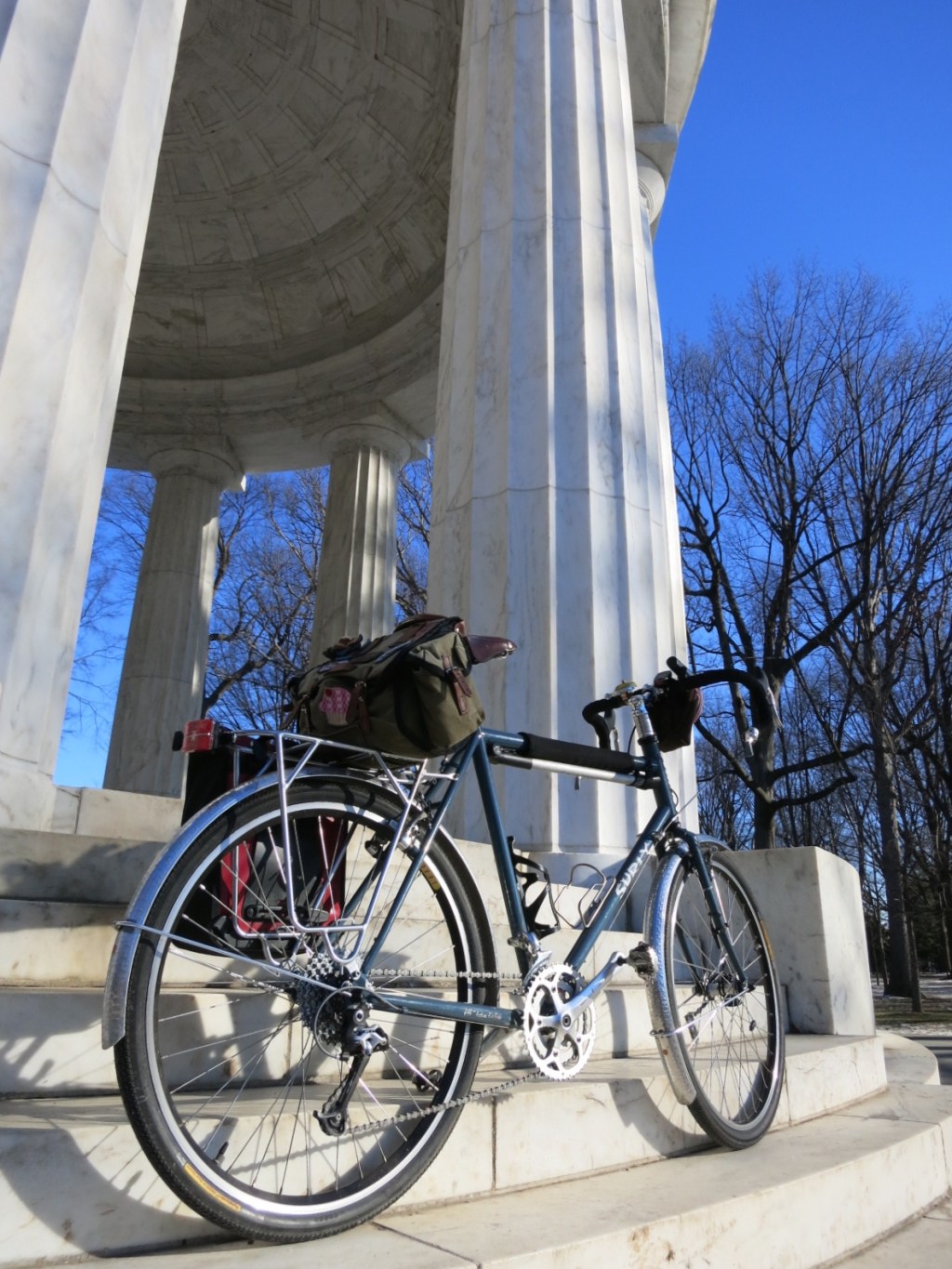
Surly LHT. Morning commute on the Mall

Surly LHT. Morning commute on the Mall

While the data I’ve come across varies, it shows that around 3 percent of the overall D.C. commuter population are cyclists. Dang, that is low!

Another figure I have read is that that women make around 30 percent of the bike trips in the District. League of American Bicyclists published data stating that 32 percent of D.C. bike commuters were women. So for every three women I see on a bike, I see another seven men riding one. I’d like to see more people commute by bike and I would love to see the ratio of men to women riders be more equal.

I don’t know all of the reasons why more people don’t ride, or why so many fewer women than men cycle. However, when I think about the reasons that I began pedaling around and continue to do so today, I see the huge role that people around me played in my development as a bike rider.

Rawland in D.C.

My story starts in a small town in the Midwest. A place where everybody knew everybody and the edge of town was always within sight, no matter where you found yourself standing.

The Big Kids

The first group to pique my interest in cycling were the “big kids” in town. Kids slightly older than I who had made the leap to riding a bicycle. Man, I envied them.

No longer constrained by their two feet, they had wheels to take them from one end of town to the other. They had left their Big Wheels behind for bigger and better things. I watched them zip up and down the street at a pace I could only imagine. I wanted to be one of the big kids.

Parents

After I added a bicycle to my wish list, my parents gathered the money together for me to have one. Initially equipped with training wheels, they watched my progress as I toodled unsteadily up and down our unpaved driveway.

Eventually, the training wheels came off. I practiced doggedly, out of view of prying eyes so no one (especially not my sisters) could monitor my progress. After hours of practice, I made the triumphant transition to big kid on two wheels.

My sisters were not far behind in mastering bicycling basics, and as we grew more confident on the bike, Mom and Dad organized occasional family rides. These rides extended my radius past the edge of town to the county roads beyond it.

Our parents exhibited great patience, teaching us how to cycle safely, and herding us slowly along the outskirts of town as the farm traffic passed us by. I will always be grateful to them for encouraging us to get outside, be active, and explore our surroundings.

Cyclists on the RAGBRAI Route

Cyclists on the RAGBRAI Route

Sisters

My sisters and I were each other’s constant companions growing up. Being close to me in age, we reached many developmental milestones perhaps not simultaneously, but within months of each other. If one sibling mastered something new, more than likely the other two took an interest in it, too.

I learned to ride, and Middle Gersemalina soon followed. It wasn’t always fun to ride alone so we spent many hours riding together. We challenged each other to try new things, like skid stops and riding no-handed.

Sometimes our trips were short jaunts to the park. Other times we meandered, exploring the streets together.

Iowans

I took up riding again as an adult for various reasons, primarily because I saw how useful it was for transport around Washington, D.C.

As I regained my cycling skills and my fitness increased, I developed an interest in bike touring. Growing up, my home state hosted the largest cross-state cycling tour in the country the Register’s Annual Great Bike Ride Across Iowa (RAGBRAI).

None of us lived in Iowa anymore, but I suggested it to my sisters as a way for us to simultaneously catch up with each other and reconnect with our home state. We made arrangements to ride it together that summer.

Our mom even agreed to follow the route (by car) and carry our cycling gear from town to town. Ultimately, only one of my two siblings was able to ride it, but we loved it.

There is nothing quite like seeing people come from all parts of the country to ride in the state where you spent your childhood, especially when tourism is not a big draw to that part of the country. My sister and I liked RAGBRAI so much that we did it together a couple of times.

Andrea on the 2012 D.C. Randonneurs 600K

Andrea on the 2012 D.C. Randonneurs 600K

My Friend Andrea

During one of my RAGBRAI trips, I met an avid D.C.-area cyclist, Andrea M. She took me under her wing after RAGBRAI, and introducing me to road riding and the great places to ride outside of Washington, D.C. She showed me the roads around Poolesville, Maryland; the popular cycling highway that is River Road; and Sugarloaf Mountain.

Up until that time, my D.C. riding had been limited primarily to multi-use paths. Thanks to Andrea, a whole new cycling world opened up to me. I even discovered randonneuring when Andrea invited me to be part of an all-woman fleche team.

Felkerino

Because of Andrea, I reacquainted myself with groups of people who liked riding for sport and recreation, and in the process I realized how much cycling meant to me. I loved meeting people who shared my passions for being active.

It was through this group that I met my tandem partner, and now-husband, Felkerino. Felkerino not only possessed knowledge about good places to cycle, but he was also a smarty-pants about how the bicycle worked. He taught me enough mechanical skills to muddle through basic roadside repairs (emphasis on basic).

Felkerino, Crista, and Chuck

Randonneuring and Touring Friends

Felkerino and I also learned the ins and outs of light/”credit card” bicycle touring together, thanks in large part to some of our randonneuring friends who welcomed us to tour with them. They taught us about route and distance planning, and how to plot one- to two-week tours.

Felkerino and I then set off on our own, basing our routes on much of the touring knowledge we acquired from then.

Felkerino and me, with Rob Hawks on PBP 2011 (c) Antoinette Galon

Felkerino and me, with Rob Hawks on PBP 2011 (c) Antoinette Galon

And so it goes.

In a time where so much information is available to us and often only a keyboard click away, I have found that it can only take me so far.

Ultimately, I needed the people around me, the spokes of my wheel of influence, to send me on my way. They taught me about the bicycle and fostered my cycling pursuits. They invested their time in helping me. It’s hard to imagine where I would be without them.

I’m forever grateful to the many people who opened my world to bicycling, and to those who continue to influence and inspire my two-wheeled adventures.

Looking Ahead Without a Spreadsheet

Stopping by Dyke Marsh on a New Year's Eve ride

Stopping by Dyke Marsh on a New Year’s Eve ride

As mentioned in a previous post, I track the miles I run and ride. I keep tabs on the number of days I do each activity.

Bike ride? Check.
Trip to the gym? Check.
Miles ridden or run? Write them down.

I usually take great pleasure watching the trips and miles add up over the days and months until they culminate into a great big digit fest at the end of the year.

Enthusiastically I review and compare the information, consider what the various numbers mean, and draft out plans and goals for the upcoming 12 months.

This December, I found myself scrutinizing all the digits and instead of feeling fun, it felt like math homework. Rather than the numbers revealing something exciting, they just sat there looking at me blankly from within their cell on a spreadsheet.

In the end, the story the numbers told was the following: I have been on the same basic program for the past three years. Same overall mileage, same number of days ridden, and the same number of trips to the gym. The only difference was that my 2012 running mileage increased noticeably from 2011.

I think I would be ok with the story of sameness, had I felt like my program was satisfying. But it feels like something was missing from my 2012 endeavors.

This year I experienced an overhwelming, albeit brief, urge to quit on a brevet simply because I was not into the ride. There was nothing physically wrong. I wasn’t bonking. The weather was not unpleasant. The distance did not intimidate me. The course was pretty. I just did not want to be riding my bike 300 kilometers that day.

That desire to quit shook me. If I ride the brevets, I want to be all in. If I time out or something happens that’s outside of my control, fine. But to mentally check out? That is not acceptable and it is something I need to think about for this upcoming year.

DC Randonneurs 600K. Shadow Panda. Obligatory Cow Photo

Given my waning enthusiasm midway through the Super Randonneur series, I was proud of Felkerino and I for our perseverance. We thoroughly dug in and enjoyed ourselves on June’s 600K brevet, which was also a qualifier for the 1200K distance. We agreed to focus on forward momentum and be efficient at the controls and any other stops.

Our solid team effort on the 600K redeemed my confidence in us taking on the Colorado High Country 1200K in July. As long as we could execute a similar plan in Colorado, we would be good.

To my relief, the High Country 1200K proved to be the event highlight of my year. Incredible course. Good riding company. Felkerino and I rode well and were synchronized throughout. While the year did not necessarily leave me feeling satisfied, the Colorado High Country certainly did.

As I noted in my wrap-up post, 2012 stands out largely because of all the new people we met, particularly the BikeDC community. It was not a year about numbers.

That said, I want 2013 to be different. I don’t care if the miles are the same. I don’t wish to ride or run fewer miles or even less frequently. I want to allocate the miles differently somehow. What that means in concrete terms, I am still puzzling through.

Maybe I need to throw my spreadsheet away.

2012 in Review: Variety is the Spice of Life

Another December passes, the sun sets on 2012, and I find myself reflecting about the activities of the past year.

Sunset on Day 1 of the Colorado High Country 1200K

While Felkerino and I focused on preparing for and completing Paris-Brest-Paris in 2011, our 2012 cycling proved more varied.

We commuted, completed a Super Randonneur series with the D.C. Randonneurs, trained to ride the Colorado High Country 1200K, rode more dirt roads, and planned a weeklong bike tour of Southern Virginia.

Bike touring in Southern Virginia

Bike touring in Southern Virginia

We also organized the D.C. Randonneurs 400K, which gave us new appreciation for all the work that goes into executing the brevets.

Waiting up for the 400K Riders (c) Bill Beck

Waiting up for the 400K Riders (c) Bill Beck

I ran two marathons (one in March and another in October) and spent more time cross-training at the gym. I enjoyed mixing up the running and the bike rides. Running is a different pace and perspective, and it works my muscles and mind in ways that are distinct to cycling.

2012 Rock and Roll Marathon Bib and Finisher's Medal

March 2012 Rock and Roll Marathon Bib and Finisher’s Medal

Because of the unfortunate state of our Co-Motion tandem, I also rode a fair number of weekend rides on my single bike. That made for an invigorating change of pace.

Riding the Rivendell Romulus on the D.C. Randonneurs Flatbread 200K (c) Felkerino

Riding the Rivendell Romulus on the D.C. Randonneurs Flatbread 200K (c) Felkerino

The best part of 2012, though, ended up being all the people I met and spent time with via the various riding Felkerino and I did.

Friday Coffee Club. Through Friday Coffee Club, a weekly morning gathering of D.C. bike commuters at Swings Coffee, I came to know the #BikeDC community.

Friday Coffee Club

We often encountered each other during local event rides, like this fall’s 50 States Ride.

#fridaycoffeeclub peeps on this summer's 50 States Ride

#fridaycoffeeclub peeps on the 2012 50 States Ride

Some even made the daring cross over to randonneuring.

Chris from Friday Coffee Club and Felkerino on the DCR Flatbread 200K

Chris from Friday Coffee Club and Felkerino on the DCR Flatbread 200K

BrevetsRandonneuring rides provided a venue (and the time, lots of time) to catch up with old rando-pals and to meet new ones.

George, Christian, and Rick on the Warrenton 300K

George, Christian, and Rick on the Warrenton 300K

Alec, Eric, and Mike on the Urbana 200K

Alec, Eric, and Mike on the Urbana 200K

Barry B. on a training ride out of Middleburg

Barry B.

CoffeeneuringOver 60 people participated in the Coffeeneuring Challenge, some of whom (like Lynne from Oregon and George of New York) I met in person and others I connected with through the ether.

Lynne F., Oregon randonneur and coffeeneur

Lynne F., Oregon randonneur and coffeeneur

George Swain, randonneur and coffeeneur

George Swain, New York randonneur and coffeeneur

To all of you who coffeeneured and utilitaired and wrote up the stories of your rides, a huge thank you!

Colorado High Country 1200KNot only was the course awesome and the weather perfect for all four days of the Colorado High Country 1200K, but we also rode with friendly and good-spirited people. Many laughs, rich conversations, and sublime moments happened during that ride.

Colorado High Country 1200K

Colorado High Country 1200K

Felkerino and Bill on the Colorado High Country 1200K

Felkerino and Bill on the Colorado High Country 1200K

Rabbit Ears Pass on the Colorado High Country 1200K

Rabbit Ears Pass on the Colorado High Country 1200K

Dave, Bill, and Felkerino on Day 4 of the High Country 1200K

Dave, Bill, and Felkerino on Day 4 of the High Country 1200K

The FlècheAnd our flèche team? Well, I love our flèche posse. I can’t imagine a better 24 hours of pedaling.

2012 Fleche Team (c) Bill Beck

2012 Fleche Team (c) Bill Beck

Thanks to everybody who made this such a fun and fulfilling year. Thank you for reading, commenting, and riding with us.

I don’t know what awaits us in 2013, but I’m hoping for more days full of friendship, fresh air, and adventure.

<3