
This year, I began to be more deliberate about how I eat during brevets, especially the 400K and 600K distances.
I’m not the best eater nor am I a nutrition expert, but I have ridden a fair number of long rides up to 1200K distances employing both good and regrettable fueling strategies over the years. Experience has been a fine teacher.
When I first started on my randonneuring career path, I remember being told “If it looks good, you should eat it. Your body is craving it.” Simple advice that was easy to apply, I attempted that strategy for a few years, with really mixed results.
Essentially, I found this approach ultimately enabled a bad mentality of justifying poor food choices under the guise of “I’m exercising, it’s okay.” Oh, and I ended up with some pretty terrible stomach-aches, too.

I have taken a sharp turn away from the “If it looks good, you should eat it” method (unless you haven’t been able to eat anything at all that day for some reason, and then maybe). Instead, I strive for bland, easily digestible foods and drinks that won’t pay me a return visit in ways I dislike.
In addition, I have learned that my exertion level as well as time of day also determines my body’s digestion abilities. If I’m working really hard, my food is going to have a more difficult time going through the system. The window of 3 to 6 a.m. does not allow me to eat much. My body is completely confused, and eating and digesting is not at the top of its to-do list.
Hey, where is the actual food part of this post, you might be asking. It’s coming, I promise, but brevet riding is more complicated than regular daily fueling, You are often eating on the run, nibbling in-between and during big miles, and consuming around the clock during times when the body might typically be doing other things, like say, reading a book, or perhaps sleeping.
Nutrition isn’t something to think about only during a ride. Ride nutrition is, of course, a subset of one’s overall diet. However, I’m not going to talk about all that today, as the focus here is my on-the-bike fueling.
This year I learned that the more fuel Felkerino and I prepare in advance of a ride, in combination with our anticipation of what will be available at stops along a route, the more time we save and the better food choices we make.
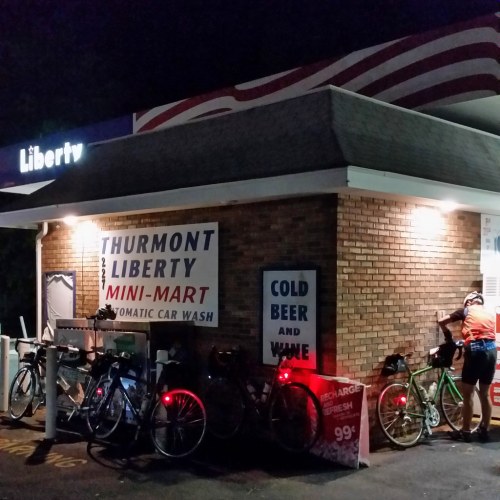
A day’s temperatures combined with a ride’s duration drive what can readily be stored in a Carradice or in the back-pocket cafe. For that reason, I stay away from meat products.
Instead, I often make almond butter or hummus sandwiches for 300K, 400K, or 600K brevets. This year, I was all about the almond butter and honey on some kind of whole-grain bread. This gives me a nice combination of fairly bland carbs, natural sugar, and protein.
Adding honey to the sandwich means it is moist, but I can easily store in my rear pocket or the Carridice bag, and (unlike something like a turkey sandwich) it never becomes slimy or horrible to consider eating at any point. Almond butter and honey on whole-grain bread constitutes an inoffensive, easily digestible, on-the-go meal.
If a rides starts at 5 a.m. or earlier, my body has a tough time eating anything before-hand, and I fill my pockets for post-sunrise munching. Usually, I eat a banana and a couple of bites of an almond butter sandwich before a brevet, but that is all my stomach will handle at that hour.
Generally, my back-pocket food stash consists of the following:
- 2-3 almond butter sandwiches, nibbled on throughout the day.
- 2 bananas (and buy more on the route when needed, and if possible). Excellent sources of potassium that go through the system without a fuss.
- 2 Lara bars, which I prefer for their taste and digestibility, or Clif Bars in a pinch (I generally find Clif Bars to be dry and not as easy to eat or digest)
- 2 Clif Shot Block packages– one with caffeine, and one without (for bonking prevention)
- 2 liter Camelbak full of water
This is my food and drink foundation, and I add to it with what we eat along the way at controls or critical stops on the route. (Note: this food is not literally all in my pockets. Some of it is in the Carradice, too!)
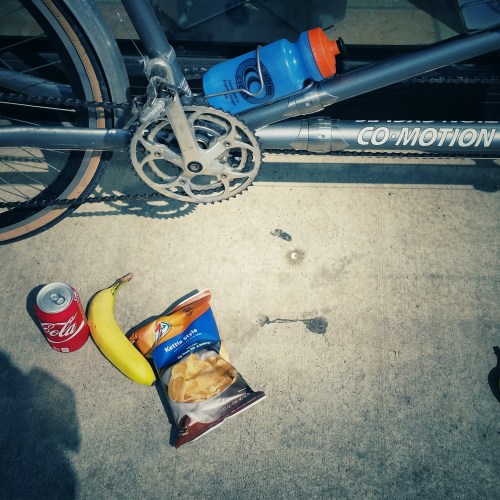
Despite being a huge fan of sweets, during rides I usually crave salt and carbs, and some protein. For me, plain kettle-cooked chips (from Lays, Route 11, or Cape Cod. Sorry Utz, you don’t cut it) are just the additional kick for me at a 50-mile break.
Route 11 sweet potato chips are my absolute favorite. Felkerino developed a Frito’s affinity late last year– a rich oil, fat, and salt combination– but he didn’t seem to crave them as much this year. I generally avoid eating French fries because they are usually too greasy for my system to handle.
Tomato or V-8 juice is another way to curb my sodium craving. Generally, tomato juice goes down easy, and I believe it is also a source of calcium.
As I mentioned earlier this week, Felkerino and I stopped drinking Gatorade, deciding it was too sweet and unsatisfying. Felkerino started using Skratch on the bike (I generally prefer water on the bike), and we both switched to drinking a mix of sweet and unsweetened tea as alternatives to water when we make a store stop. Sometimes we split an apple juice, which offers some potassium as well as sugar (and carbs too, maybe?).
I drink a Coke now and then during a ride. Generally, I despise Coke, but sometimes the caffeine and sweet, along with who knows what other chemicals, hits the spot. The red ambulance, our friend Jerry says. I can’t generally drink an entire can of Coke, but 6-8 ounces on occasion are alright.
This year, we tended to stop for one real meal during a ride, and for me, that usually meant a basic turkey sandwich or a slice of cheese pizza. I don’t know why, but my body has no problems with cheese pizza, as long as I limit myself to a piece or two. It seems to have the ideal salt, fat, and grease combination I want on my rides.

I would like to eat healthier during rides most days, but find that the 400K and 600K rides don’t set up well for that. It takes up too much space and weight in the back-pocket cafe and Carradice bag.
Since most of our stops are at convenience stores, I have based my food choices around what is available there. On rare occasions where we can stop at a place with a fuller menu and healthier options, we will take advantage of it.
I used to prefer eating a substantial amount whenever we would stop at a control or store. By doing this I felt like I avoided the inconvenience of pulling food in and out of my rear pockets as we rode along.
However, I’ve found that eating small amounts as we ride works much better for my body. I don’t have as many issues with bonking, and my stomach doesn’t give me as much guff, either. I feel a better flow of energy.
Ice cream, Little Debbie snack cakes, beer, jelly beans, chocolate, and bacon are all among the foods that have ended up on my skull and crossbones brevet food list. Others may be able to eat them, but they are too high-risk for me.

Like many aspects of randonneuring, the food and drink system is highly subjective and requires regular evaluation, since what works one year may falter the next. For now, this is what’s doing the trick for me.
If you have any suggestions for additions to the back-pocket cafe, especially ones that are easy to prepare, please let me know. Just as it’s good to have regular and reliable choices, I’m always looking for new items to add to the brevet mix.


 Chasing Mailboxes