
As I looked through the coffeeneuring submissions, I thought it might be fun to share a few more facts about the 2012 coffeeneuring community. So hang onto your helmets and be prepared to be wowed by my data mining skills.
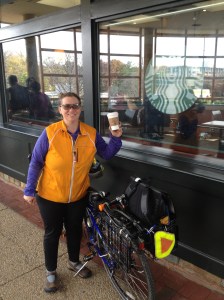
The first topic I thought I’d cover is the participation of women versus men in the challenge.
This is of interest to me because
- I am a woman; and
- Women currently make up far less of the general cycling population than men.
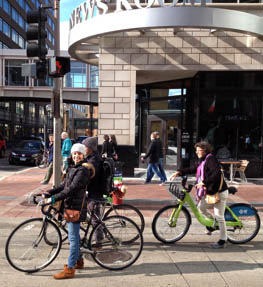
On its website, Bikes Belong mentions a 2009 study by the Department of Transportation that found women made up about 24 percent of total bicycling trips in the United States. The site notes another statistic from Scientific American stating that men’s cycling trips surpass women’s by at least 2-to-1. I wondered how the coffeeneuring participation rate of men versus women would measure up by comparison. Would it, like these studies, also reflect a much higher rate of male versus female participation?
The answer is “no.” The 2012 Coffeeneuring Challenge data show that both men and women like to coffeeneur.
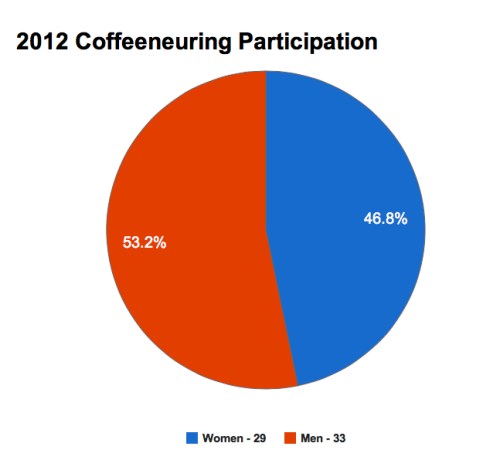
While more men than women participated in the challenge, the difference between the two groups was not great. Of the 62 total participants, 29 were women and 33 men. Overall, a fairly balanced participation rate existed between the genders.
A look at participation outside of the United States shows a total of six coffeeneurs, five women and one man. Of course, the participation rate outside of the United States only amounted to ten percent of total coffeeneurs, but it did surprise me that all except one were women.

What is it about the Coffeeneuring Challenge that encouraged such a high participation rate among women, when the average number of cycling trips in the made by women compared to men in the U.S. is 24 percent?
I don’t know the demographics of the blog’s readership by gender, but perhaps more women than men read it, meaning more women than men were aware of the challenge.
As I mentioned in a previous post, I identified ten two-person teams that coffeeneured together, and all of these were co-ed. Could it be that there is a social aspect of the challenge that appeals to women? Maybe the appeal of a bike ride with a steaming hot beverage in a local coffee shop as the destination equally appeals to both genders? If you have any thoughts on the matter, I’d love to read them.
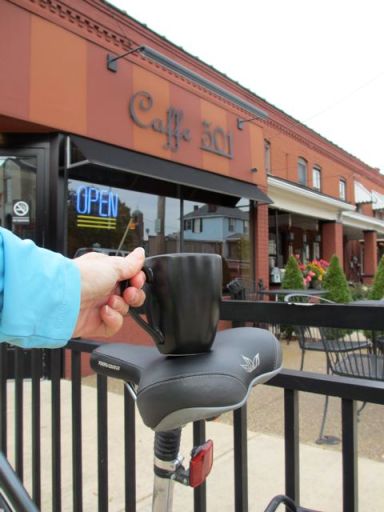
I’m ecstatic that so many people took on the 2012 Coffeeneuring Challenge, and that both women and men wanted to be part of it.


 Chasing Mailboxes